
Reward and Advancement
The offshore wind industry has expanded rapidly in the UK in the last ten years and it is still an early stage industry on the world stage. The industry in Scotland will experience a huge growth spurt in the lead up to 2030, and the decade beyond, with the bulk of the 30 plus projects in the ScotWind and INTOG leasing rounds to be built out in this period.
This represents an investment of over £80bn to deliver all of these projects and will require a workforce of up to 95,000 people in the offshore wind industry. This means that companies will be competing with each other to attract the right staff and thus ensuring that wages will remain competitive, if not higher than, compared to jobs in most other UK industries.
Even if you join at an entry level position the sheer scale of this expansion will drive rapid advancement and promotion across the industry.
A list of industry jobs and projected salary levels can be found on our Job roles in offshore wind page
Global Opportunity
Given Scotland's ambition to be a world leader in offshore wind and the fact that we are already one of the world's leading countries for floating wind, there will be the opportunity to take your learning and experience to other global markets.
Many countries around the globe are waiting on floating wind to be reduced in cost before they will begin to deploy the technology in their own coastal waters. They will be looking for assistance from the early technology adopters, like Scotland, to help them deliver their own floating wind projects in the near future.
Scotland's expertise in subsea engineering for the oil and gas industry was exported to markets all over the world and led to the growth of our subsea supply chain companies and their international presence for over three decades. Floating wind now offers a new generational 'second wave' of Scottish expertise to be exported to deep water markets worldwide.
A career in offshore wind will bring not only financial reward but the chance to be a pioneer in a new era of technology expansion that will benefit a huge proportion of the global population. And, if that is not enough, it will be one of the main generation technologies to help combat climate change (see link below).
So, the next time someone says that that cutting carbon emissions in Scotland is a waste of time due to our small impact on total global emissions, tell them about Scotland's role in the 6th Industrial Revolution and how we will export this knowledge to the world. Choose to work in offshore wind and you can be part of this story.
Job Security
Offshore wind is now a rapidly expanding global industry. Almost every country with a coastline and a suitable wind resource is looking to harness the power of offshore wind.
The projects themselves are increasing in scale and complexity. By 2030-33 Scotland will be home to the largest offshore wind project in the world, the 4.1GW Berwick Bank project in the Firth of Forth. This project is so large that it will have to be built in phases over a 6 year period and the recent award of a Government Contract for Difference (CfD) will kickstart the build out of the first 1.4GW phase. The CfDs being awarded to offshore wind projects in the UK are currently for 20 years which should ensure that Berwick Bank will be contributing to lowering CO2 emissions right up to 2050 and beyond.
While other major renewable energy technologies, such as solar PV and onshore wind, are restricted by factors such visual intrusion, distance to demand market and competing land use, offshore wind has the advantage of avoiding some if not all of these issues.
Major global population centres tend to be on the coast or on large rivers, so offshore wind can be placed relatively near such demand centres but be far enough offshore to reduce visual intrusion. This means that offshore wind can scale to Gigawatt levels with a much smaller footprint than similar scale projects on land, mostly due to their ability to use huge wind turbines. While care is taken when sighting such projects to avoid competition with other sea users there will be some level of displacement involved (e.g. fishing) and government planning authorities have to weight up the pros and cons of every offshore wind project on their own merit. For the ScotWind and INTOG rounds the Scottish Government consulted with the fishing industry to minimise such displacement when planning the leasing rounds.
Clean Power 2030 and Net Zero 2050 Target
This ability to scale means that offshore wind will be the largest contributor to the UK's Clean Power 2030 and 2035 targets (43-50GW) and that the installed capacity expected to reach the Net Zero 2050 target will have to be up to 140GW. This huge increase will be required to meet an ever increasing electricity demand in the UK as we move to not only electrify heat and transport but meet significant power demand from AI date centres. Alongside these new areas of demand there will be significant demand for hydrogen generation from electrolysis to help the hard-to-abate industries such as steel, chemicals, aviation and shipping.
To put this into perspective the UK's current installed capacity is 16.6GW (Jan 2026). Therefore to achieve the UK's Net Zero targets the industry will need to install at least 50GW per decade in the lead up to 2050.
This will require a significant effort from industry and government to exceed the 100GW mark and represents a long period of job security for a dedicated offshore wind workforce that will take us to 2050 and beyond.
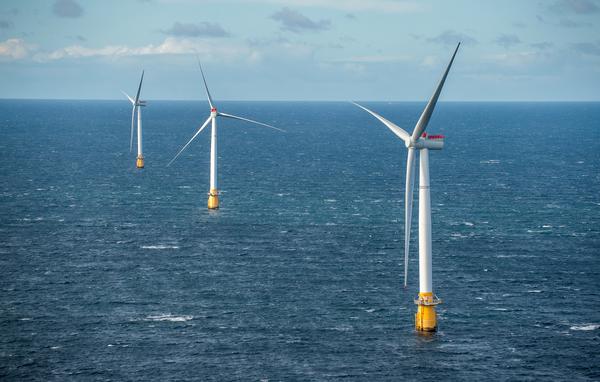
Join a huge global industry expansion
The energy transition is already underway and offshore wind in Scotland is at the forefront of this movement. As we move away from fossil fuel based power and heat to protect our fragile planet we need to replace them with clean, green power.
Offshore wind is one of the main tools we have in our energy solutions toolbox to achieve Net Zero.
A career in offshore wind
With over 10 years of project pipelines and active lifetimes of over 20 years, offshore wind farms are offering generational job opportunities both at their delivery and operational stages
Cutting edge technology
Scotland's offshore wind industry is pioneering the use of floating wind. With 80% of the world's wind resource in deeper waters you can take your experience to international markets for those who want to travel the globe
Combating climate change
The sheer scale of offshore wind projects mean that the industry is one of the biggest green generation technologies when it comes to replacing fossil fuel energy